
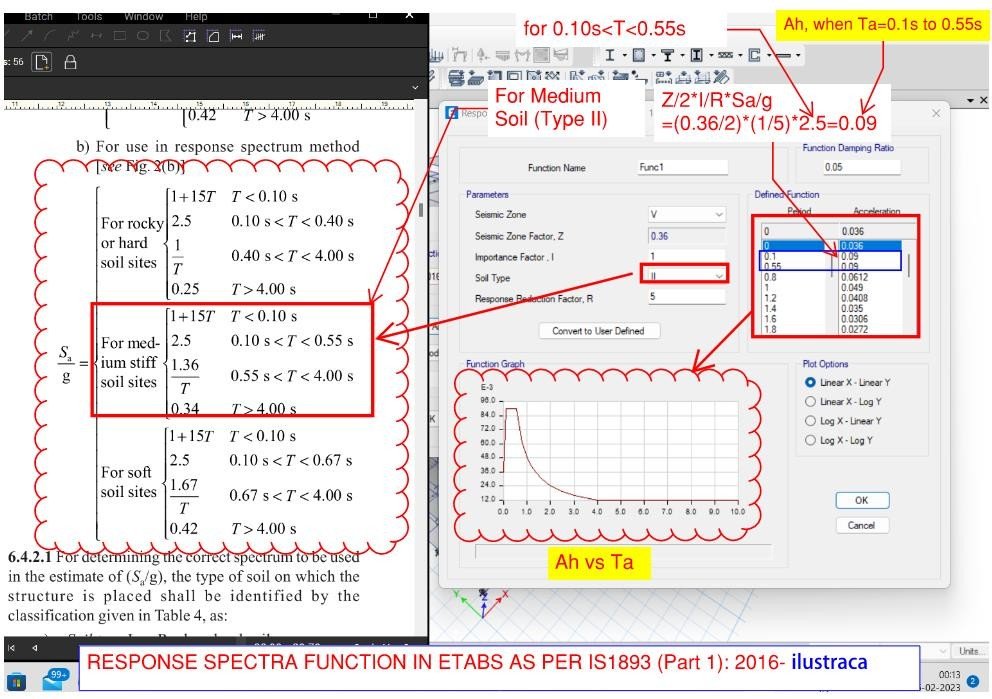
I have attached an image here to explain how the Response Spectrum Function is defined in ETABS as per IS 1893 (Part 1):2016. While using any software program, understanding the inner algorithm is very important.
Hence, I have tried to break down one such topic in this article.
Why g goes into the scale factor
In ETABS, the IS 1893 (Part 1):2016 response spectrum function takes the Seismic Zone Factor (Z), Importance Factor (I), Response Reduction Factor (R) and Soil Type. So the function values are already the design horizontal acceleration coefficient:
Ah = (Z/2) × (I/R) × (Sa/g)
e.g. Zone V, I = 1, R = 5, medium soil: (0.36/2) × (1/5) × 2.5 = 0.09
This value is dimensionless. ETABS, however, computes the response spectrum load as an inertia force, mass × acceleration, using the seismic mass defined in the Mass Source (dead load plus the specified percentage of live load, as per IS 1893). Mass is weight divided by g (M = W/g).
That is why the initial scale factor of the Response Spectrum Load Case is only g = 9806.65 mm/sec². It converts the seismic mass back into seismic weight:
F = M × g × Ah = W × Ah
This is exactly the IS 1893 base shear form VB = Ah × W. I and R are not repeated in the load case, because they are already inside the function.
Note: if a function is defined with Sa/g alone (for example, from a user-defined file), then Z, I and R must go into the scale factor instead, as g × Z × I / (2R). The CSI Knowledge Base explains the same idea for ASCE 7, where the scale factor is I·g/R: Scale factor in RSA (CSI Knowledge Base).
Learn more
For more such content, visit my YouTube channel ilustraca. Related video: Response Spectrum Function Generator: IS 1893 (Parts 1 & 5):2025.
Originally published on LinkedIn on 15 February 2023.